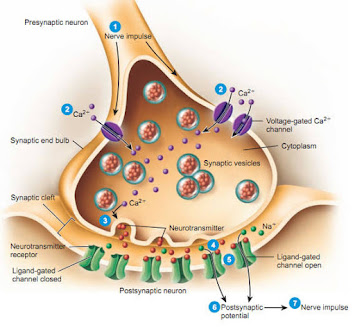
The brain has possibly 100 billion neurons, each of which connects to up to 10,000 (typically) other neurons. By some estimates, there are over 100 trillion total connection points or "synapses" in the human brain. As information flows through the neural circuits and networks of the brain, the activity of the neurons causes the connection points to become stronger or weaker in response. Our brain encodes memories by altering or changing the strength of synapses(synaptic plasticity), or connections between neurons. The mechanism behind this is called "long-term potentiation" or "LTP" This requires interactions of many proteins found in both presynaptic neurons, which send information about an event, and postsynaptic neurons, which receive the information. By strengthening and weakening the connections between synapses(the terminal of neuron) our brain stores information(memories). Now the question is how our brain strengthens and weakens connections between...
Co-ordinate bond is type of bond which is formed between two atoms in which one atom completely donates its two electron or one lone pair to second atom. What we usually see in covalent bond is that in covalent bond 1 electron is shared by one atom and the another electron is shared by II atom, so in covalent bond there is sharing of electrons. But in co-ordinate bond, the two electrons come from single atom which is called donor atom(as it donates its lone pair) and the atom to which lone pairs are donated , or we can say the atom which is receiving electrons or lone pair is known as receiver atom. Now the question arises that oxygen has 6 electrons and if it gets two more electrons, then its octet will be completed and it will become stable. During the formation of a co-ordinate bond the donor atom donates two electrons which suggests that the donor atom has two free electrons which are not involved with any other atom in bond i.e., they are just free to use. So why ...
Now a days due to pollution, our atmosphere has become toxic chamber that it is very difficult to live a healthy life in such a toxic environment. The quality of air that we breathe in, has reduced to a great extent. Due to industrial revolution, large amount of vehicles and deforestation, the amount of toxic gases like carbon dioxide has increased enormously and pure oxygen quantity is getting reduced day by day(Ozone depletion) due to which the balance of all the gases in our environment is getting disturbed which is an alarming situation. When we think about these global alarming problems, some interesting questions strike our minds; Can we build a device that converts carbon dioxide to oxygen? If yes, then How? If plants can convert Carbon-dioxide into oxygen then, can we also make such a machine or device that can convert CO2 into O2? These questions often strike our mind and I am sure that at some point in your life, you also got striked by these kind of questions. So ...



0 Comments